In many economic and financial applications, predicting a single value (a “point forecast”) is not enough. We often need to understand the full range of possible outcomes and their likelihoods. This requires us to move from point forecasts to distribution forecasts—also called density forecasts when the outcome is continuous and the forecast is given by a density.
For econometricians, this matters whenever decisions depend on tail risk, uncertainty, or the full conditional distribution rather than only the conditional mean. Examples include inflation fan charts, recession-risk assessment, and risk-management quantities such as Value-at-Risk (the loss threshold exceeded only with a given small probability).
This chapter explains how to evaluate such forecasts in a way that rewards honest uncertainty quantification rather than only accurate point predictions.
4.2 Roadmap
We begin by clarifying the difference between point forecasts and distribution forecasts.
We then introduce proper scoring rules, the basic tools for evaluating predictive distributions.
We study the two most important univariate scoring rules in practice: the logarithmic score (LogS) and the continuous ranked probability score (CRPS).
We then turn to calibration diagnostics using the Probability Integral Transform (PIT).
We then connect these ideas back to information theory, especially cross-entropy and the Kullback–Leibler (KL) divergence.
Finally, an empirical application puts the toolkit to work on U.S. gross domestic product (GDP) growth: an autoregressive benchmark and two flexible machine-learning density forecasters are compared with scoring rules and calibration diagnostics on real data.
4.3 Distribution Forecasts vs. Point Forecasts
A point forecast reports one value, such as “tomorrow’s inflation will be 2.5%.” Under mean squared error (MSE), the optimal point forecast is the conditional mean; under mean absolute error (MAE), any conditional median is optimal. These losses evaluate a single reported summary rather than the rest of the predictive uncertainty.
A distribution forecast instead reports the entire conditional distribution of Y_{t+1} given the forecast-origin information set \mathcal{F}_t. It therefore describes not only location but also dispersion, skewness, and tail risk. This additional information matters whenever the decision depends on more than the expected outcome. Examples include:
Inflation Forecasting: Central banks are interested in the probability of inflation exceeding a certain target, not just the single most likely value.
Risk Management: Financial institutions need to estimate the distribution of potential losses (e.g., Value-at-Risk at multiple risk levels).
Policy Analysis: Governments need to understand the range of potential impacts of a new policy under uncertainty.
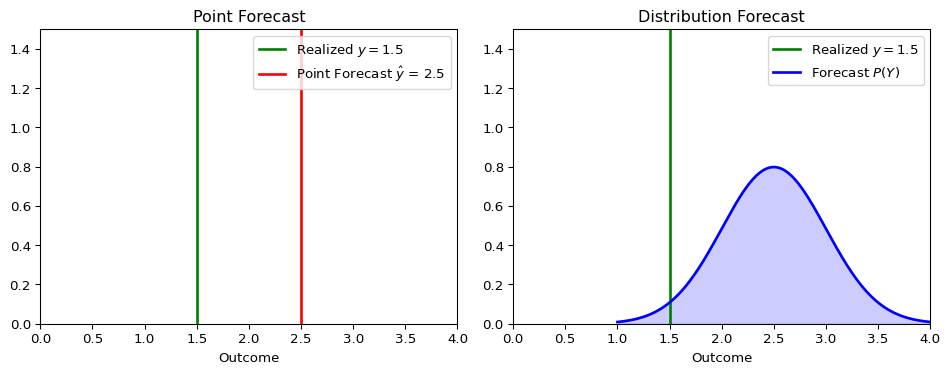
The figure below illustrates the conceptual difference.
Figure 4.1: Comparison of a point forecast and a distribution forecast for the same outcome. Left panel: the realized value (green vertical line) and a point forecast (red vertical line). Right panel: the same realized value against a full forecast density (blue curve with shading); the forecast now specifies a complete predictive distribution over possible outcomes rather than naming a single one.
A point forecast provides a single best guess, while a distribution forecast provides a richer view of what might happen.
Evaluation Workflow
In practice, evaluating distribution forecasts usually has two components:
Scoring rules to rank competing forecast models with a single numerical criterion.
Calibration diagnostics to understand why a forecast distribution is failing.
The LogS and the CRPS, introduced below, address the first task. PIT histograms (Section 4.8) address the second.
4.4 Proper Scoring Rules
To evaluate a distribution forecast, we need a metric that assesses the quality of the entire predicted distribution, given the one outcome that actually occurred. This is the role of scoring rules.
A scoring rule S(P, y) assigns a numerical score to a forecast distribution P when the outcome y is realized, just like MSE assigns an error to a point forecast \hat y and y.
Definition of Proper Scoring Rules
Let \mathcal{P} be a class of predictive distributions on the outcome space. A scoring rule S(P,y) assigns a real-valued score to each combination of distribution P \in \mathcal{P} and outcome y, and we assume throughout that \mathbb{E}_{Y \sim F}[S(G,Y)] is finite for every F, G \in \mathcal{P}. Under our loss convention (lower is better), S is proper on \mathcal{P} if reporting the truth is optimal in expectation:
\mathbb{E}_{Y \sim F}[S(F,Y)] \leq \mathbb{E}_{Y \sim F}[S(G,Y)] \quad \text{for all } F, G \in \mathcal{P}.
We call Sstrictly proper if the true distribution is the unique minimizer. This is analogous to how the conditional mean is the unique forecast that minimizes MSE: proper scoring rules incentivize honest reporting of the entire predictive distribution. Note also that the object \mathbb{E}_{Y \sim F}[S(G,Y)] is nothing new in kind—it is the generalization risk of the cross-validation chapter, with the scoring rule playing the role of the loss function and a whole distribution playing the role of the forecast.
For dependent data, propriety is a statement about the conditional distribution being forecast. At each forecast origin t (see the definition in the Cross Validation chapter), the reported distribution should be measurable with respect to \mathcal{F}_t and should target the law of Y_{t+1}\mid\mathcal{F}_t. Averaging proper scores over time then compares sequential conditional forecasts, but serial correlation in the score differences matters for uncertainty assessment and forecast-comparison tests.
Some authors define propriety with the reverse inequality, treating S as a utility rather than a loss; the two conventions are equivalent up to a sign. For technical details and the general theory, see Gneiting and Raftery (2007).
Misunderstanding Proper Scoring Rules
Proper does not mean “better”; it means that the rule encourages honest reporting.
Different proper scoring rules can rank models differently.
If possible, the choice of scoring rule should align with the specific decision problem.
Why Proper Scoring Rules Matter
They encourage forecasters to be honest and report their true beliefs.
They provide a principled way to compare the performance of different forecasting models.
They prevent “gaming” of evaluation metrics that might occur with simpler ad hoc measures, as the example below shows.
The Gaming Problem with Improper Scoring Rules
Suppose we evaluate forecasters using only empirical coverage of their 90% prediction intervals: the forecaster whose realized coverage rate is closest to the nominal 90% is declared best.
A Gaming Strategy: Under this criterion, a strategic forecaster could report an extremely wide interval such as [-1000,1000] for inflation in 90% of forecast origins and an empty or irrelevant interval in the remaining 10%. This mechanically produces a coverage rate of 90% while providing almost no useful information. (A pure miss-rate criterion—the fewer misses, the better—is even easier to game: always reporting (-\infty,\infty) never misses.)
This makes coverage alone an improper evaluation criterion. Proper scoring rules include a penalty for uninformative or underconfident forecasts rather than rewarding coverage alone.
Two of the most widely used proper scoring rules are the LogS and the CRPS.
4.5 The Logarithmic Score (LogS)
The LogS evaluates the forecast density at the realized outcome. For a forecast with probability density function (PDF) f and realized outcome y, it is defined as
\text{LogS}(f, y) = -\log f(y)
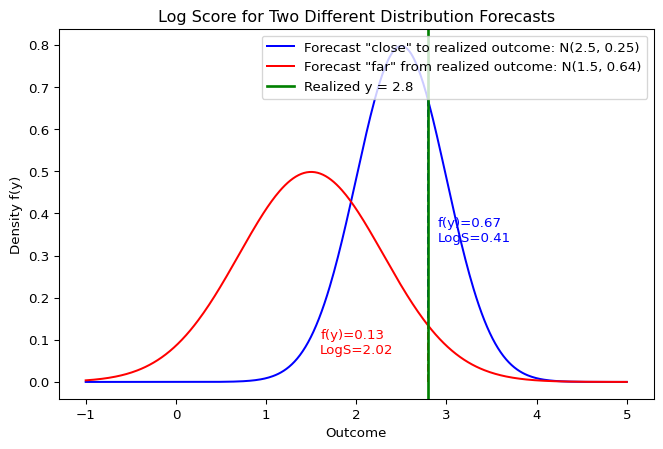
Lower scores are better. Because the LogS depends only on the height f(y) of the density at the realized outcome, it heavily penalizes a model that assigns little density to an outcome that occurs. This local evaluation also means that the forecast must supply an explicit density. Figure 4.2 illustrates the mechanism: the forecast that places more density at the realized value receives the lower score.
Show the code
import numpy as npimport matplotlib.pyplot as pltfrom scipy.stats import normfig, ax = plt.subplots(figsize=(8, 5))y_realized =2.8x = np.linspace(-1, 5, 400)# Good forecastmu_good, sig_good =2.5, 0.5pdf_good = norm.pdf(x, mu_good, sig_good)ax.plot(x, pdf_good, 'b-', label=f'Forecast "close" to realized outcome: N({mu_good}, {sig_good**2:.2f})')f_good_y = norm.pdf(y_realized, mu_good, sig_good)ax.plot([y_realized, y_realized], [0, f_good_y], 'b--')ax.text(y_realized +0.1, f_good_y /2, f'f(y)={f_good_y:.2f}\nLogS={-np.log(f_good_y):.2f}', color='blue')# Bad forecastmu_bad, sig_bad =1.5, 0.8pdf_bad = norm.pdf(x, mu_bad, sig_bad)ax.plot(x, pdf_bad, 'r-', label=f'Forecast "far" from realized outcome: N({mu_bad}, {sig_bad**2:.2f})')f_bad_y = norm.pdf(y_realized, mu_bad, sig_bad)ax.plot([y_realized, y_realized], [0, f_bad_y], 'r--')ax.text(y_realized -1.2, f_bad_y /2, f'f(y)={f_bad_y:.2f}\nLogS={-np.log(f_bad_y):.2f}', color='red')# Realized outcome lineax.axvline(y_realized, color='green', ls='-', lw=2, label=f'Realized y = {y_realized}')ax.set_title('LogS for Two Different Distribution Forecasts')ax.set_xlabel('Outcome')ax.set_ylabel('Density f(y)')ax.legend()plt.show()
Figure 4.2: Visual interpretation of the LogS. Two Gaussian forecast densities—blue centered near the realized outcome, red centered away from it—are evaluated at the same realization (green vertical line). Dashed stems mark each density’s height at the realization, with the resulting f(y) and LogS values annotated: a higher density at the realized outcome gives a lower (better) score.
Example: Calculating the LogS
Suppose we forecast that an outcome follows a Normal distribution Y \sim \mathcal{N}(\mu=2, \sigma^2=1), and the realized value is y = 2.5.
Show the code
import numpy as npfrom scipy.stats import normmu, sigma =2, 1y_obs =2.5# Calculate the PDF value at the observed outcomepdf_val = norm.pdf(y_obs, loc=mu, scale=sigma)log_score =-np.log(pdf_val)print(f"PDF value f({y_obs}) = {pdf_val:.4f}")print(f"LogS = {log_score:.4f}")
PDF value f(2.5) = 0.3521
LogS = 1.0439
4.6 The Continuous Ranked Probability Score (CRPS)
Unlike the local LogS, the CRPS compares the forecast’s cumulative distribution function (CDF) with the CDF of the realized outcome. We identify each predictive distribution with its CDF, writing Y\sim F and F(z)=\mathbb{P}(Y\le z) interchangeably. For a forecast with CDF F and realized outcome y, the score is
where \mathbf{1}\{z \geq y\} is the Heaviside step function, the CDF of a degenerate predictive distribution that places all probability mass at the realized outcome y.
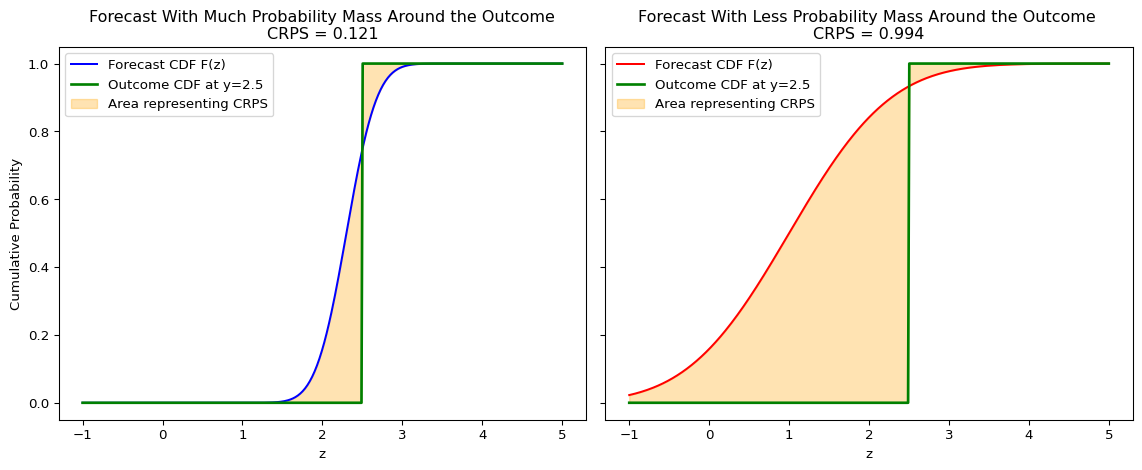
Figure 4.3 plots the squared discrepancy as an orange curve and shades the area beneath it. If the forecast places probability mass near the realization, this area is smaller and the CRPS is lower.
Show the code
import numpy as npimport matplotlib.pyplot as pltfrom scipy.stats import normimport properscoring as psfig, (ax1, ax2) = plt.subplots(1, 2, figsize=(12, 5), sharey=True)y_realized =2.5z = np.linspace(-1, 5, 400)outcome_cdf = np.heaviside(z - y_realized, 1)# --- Forecast With Much Probability Mass Around the Outcome (Left Panel) ---mu_good, sigma_good =2.3, 0.3cdf_good = norm.cdf(z, mu_good, sigma_good)crps_good = ps.crps_gaussian(y_realized, mu=mu_good, sig=sigma_good)squared_gap_good = (cdf_good - outcome_cdf) **2ax1.plot(z, cdf_good, 'b-', label='Forecast CDF F(z)')ax1.plot(z, outcome_cdf, 'g-', lw=2, label=f'Outcome CDF at y={y_realized}')ax1.plot(z, squared_gap_good, color='darkorange', lw=1.5, label='Squared CDF gap')ax1.fill_between(z, 0, squared_gap_good, alpha=0.3, color='orange')ax1.set_title(f'Forecast With Much Probability Mass Around the Outcome\nCRPS = {crps_good:.3f}')ax1.set_xlabel('z')ax1.set_ylabel('CDF Value / Squared Discrepancy')ax1.legend()ax1.set_ylim(-0.05, 1.05)# --- Forecast With Less Probability Mass Around the Outcome (Right Panel) ---mu_bad, sigma_bad =1.0, 1.0cdf_bad = norm.cdf(z, mu_bad, sigma_bad)crps_bad = ps.crps_gaussian(y_realized, mu=mu_bad, sig=sigma_bad)squared_gap_bad = (cdf_bad - outcome_cdf) **2ax2.plot(z, cdf_bad, 'r-', label='Forecast CDF F(z)')ax2.plot(z, outcome_cdf, 'g-', lw=2, label=f'Outcome CDF at y={y_realized}')ax2.plot(z, squared_gap_bad, color='darkorange', lw=1.5, label='Squared CDF gap')ax2.fill_between(z, 0, squared_gap_bad, alpha=0.3, color='orange')ax2.set_title(f'Forecast With Less Probability Mass Around the Outcome \nCRPS = {crps_bad:.3f}')ax2.set_xlabel('z')ax2.legend()plt.tight_layout()plt.show()
Figure 4.3: Visual interpretation of the CRPS. Each panel shows a forecast CDF (left panel: blue, concentrated near the outcome; right panel: red, concentrated away from it) against the step-function CDF of the realized outcome (green). The orange curve is the squared vertical discrepancy between the two CDFs, and the area shaded beneath that curve is the CRPS integrand over the displayed range. Integrating it over the real line gives the reported score, so the larger orange area in the right panel corresponds to a higher (worse) CRPS.
The CRPS has an equivalent representation in terms of two independent and identically distributed (i.i.d.) draws X,X' from the forecast distribution (Gneiting and Raftery 2007):
provided F has a finite first moment. This identity shows why the CRPS depends on both the location and spread of the predictive distribution. It also shows that the CRPS generalizes the MAE: when the forecast is degenerate at a single point, the second term is zero and the first is absolute error, as the next callout derives. Finally, the expectations can be approximated with draws from the predictive distribution, so an explicit density is not required.
Why CRPS Reduces to MAE for a Point Forecast
If the forecast distribution is degenerate at a point forecast \hat y, then X=\hat y and X'=\hat y with probability one. In the representation above,
For many standard distributions, the CRPS has a closed-form solution.
When no convenient closed form is available, the sample representation makes CRPS useful in simulation-based forecasting. If X_1,\ldots,X_M are Monte Carlo draws from the predictive distribution, the expectations in the representation above can be approximated by sample averages. This is especially practical when the model can simulate forecast paths but the predictive density or CDF is analytically inconvenient.
For a normal forecast F = \mathcal{N}(\mu, \sigma^2), the closed form is
where z = \frac{y - \mu}{\sigma}, \Phi is the standard normal CDF, and \phi is the standard normal PDF.
More closed-form expressions can be found in Jordan, Krüger, and Lerch (2019).
Example: Calculating the CRPS
Using the same forecast Y \sim \mathcal{N}(\mu=2, \sigma^2=1) and outcome y = 2.5 as above for the log score:
Show the code
# Using the properscoring library for convenience# pip install properscoringimport properscoring as psmu, sigma =2, 1y_obs =2.5crps_score = ps.crps_gaussian(y_obs, mu=mu, sig=sigma)print(f"CRPS Score = {crps_score:.4f}")
CRPS Score = 0.3314
4.7 Comparing LogS vs. CRPS
Both are strictly proper scoring rules, each relative to a specific class of forecast distributions: the LogS on classes of distributions with densities for which the expected scores remain finite—recall that finiteness is a maintained assumption of the definition, and a heavy-tailed truth against a thin-tailed forecast can violate it—and the CRPS relative to distributions with a finite first moment (Gneiting and Raftery 2007). Within these classes, they have different sensitivities.
Aspect
Logarithmic Score (LogS)
Continuous Ranked Probability Score (CRPS)
Input Required
Forecast PDF, f(y)
Forecast CDF, F(y) (or samples)
Sensitivity
Local: evaluates the density only at the realization, so one outcome in a low-density region can dominate the average score.
Aggregates CDF errors across all thresholds, so a single low-density realization rarely dominates.
Numerical implementation
Unbounded: a tiny f(y) yields a huge score. Compute \log f(y) directly (logpdf) rather than f(y) first, to avoid floating-point underflow.
Avoids evaluating tiny densities. The squared integrand is bounded by one, but CRPS itself is unbounded in the realization.
Measurement Error Sensitivity
Can be high, especially where forecast density is small.
Less sensitive: score changes by at most the absolute outcome error, though rankings can change (Kleen 2024).
Practical Rule of Thumb
Use LogS when strong penalties for assigning low density to realized outcomes are desired—its local nature makes it react sharply to tail surprises—and a full predictive density is available.
Use CRPS when a summary less dominated by single extreme realizations is desired, or when forecasts are naturally available through CDFs or simulation draws.
For a specific quantile or tail region, targeted alternatives such as the quantile scores listed in the callout below are the more direct tool.
In macroeconomic and financial forecasting, it is often informative to report both.
Question for Reflection
Within LogS and CRPS, which score reacts more sharply when a realized inflation outcome receives very little forecast density, and why? Would either score, in its standard form, directly isolate the probability that inflation exceeds a fixed policy threshold?
Suggested Answer
LogS reacts more sharply because it evaluates the density assigned to the realized outcome: if a high-inflation realization receives very little forecast density, the logarithmic penalty can be large. CRPS integrates CDF errors across all thresholds and is therefore usually less dominated by that single realization. Neither standard score directly isolates the exceedance probability \mathbb{P}(Y>c) for a fixed policy threshold c; if that event is the policy target, a proper score applied directly to the reported exceedance probability would align more closely with the question. Sensitivity to a realized tail miss is therefore not the same as targeting a particular tail event.
Beyond LogS and CRPS
Energy score for multivariate distributions Székely (2003)
Diebold-Mariano tests for comparing forecast performance (Francis X. Diebold and Mariano 1995) and the conditional predictive-ability extension of Giacomini and White (2006), which accommodates time-varying or estimated forecasting models and is the standard reference in real-time forecast evaluation; Exercise 4.3 below develops the serial-correlation issue these tests must address
4.8 Assessing Calibration with the Probability Integral Transform
Beyond comparing models with scoring rules, we often want to diagnose how a model’s predictive distributions are failing. A diagnostic built for exactly this purpose is the PIT.
The PIT is based on a fundamental statistical result: if a continuous random variable Y is drawn from a distribution with CDF F, then the transformed random variable U = F(Y) follows a Uniform distribution on the interval [0, 1].
In forecasting, we apply this principle to a sequence of forecasts and outcomes (Francis X. Diebold, Gunther, and Tay 1998). At forecast origin t, let F_{t+1\mid t} be the predictive CDF for Y_{t+1} constructed from the information set \mathcal F_t. The subscript records both the forecast origin and the date of the target. The PIT is
U_{t+1}=F_{t+1\mid t}(Y_{t+1}).
If each forecast is the correct continuous conditional distribution given \mathcal F_t, then U_{t+1} is Uniform(0,1) and independent of \mathcal F_t. Since this information set contains past outcomes and forecasts, the one-step-ahead PIT sequence is i.i.d. Uniform(0,1).
Lowercase u_{t+1}=F_{t+1\mid t}(y_{t+1}) denotes the realized PIT value computed from the realized outcome; the histograms below use these values. For multi-step forecasts, overlapping horizons can induce serial dependence in the PITs even under correct specification, so the i.i.d. conclusion does not extend to that case.
In time-series applications, probabilistic calibration means that the unconditional PIT distribution is Uniform(0,1), following the taxonomy of Gneiting and Katzfuss (2014). This property is distinct from serial independence of the PIT sequence. A histogram can look uniform even when PIT values remain autocorrelated. Correct conditional specification requires more than a flat histogram: the PIT must be uniform and independent of the full forecast-origin information set.
Calibration terminology
The density-forecasting literature uses marginal calibration for a different property: the average forecast CDF matches the unconditional CDF of the outcomes. In this chapter, calibration refers to probabilistic calibration, assessed through the PIT distribution.
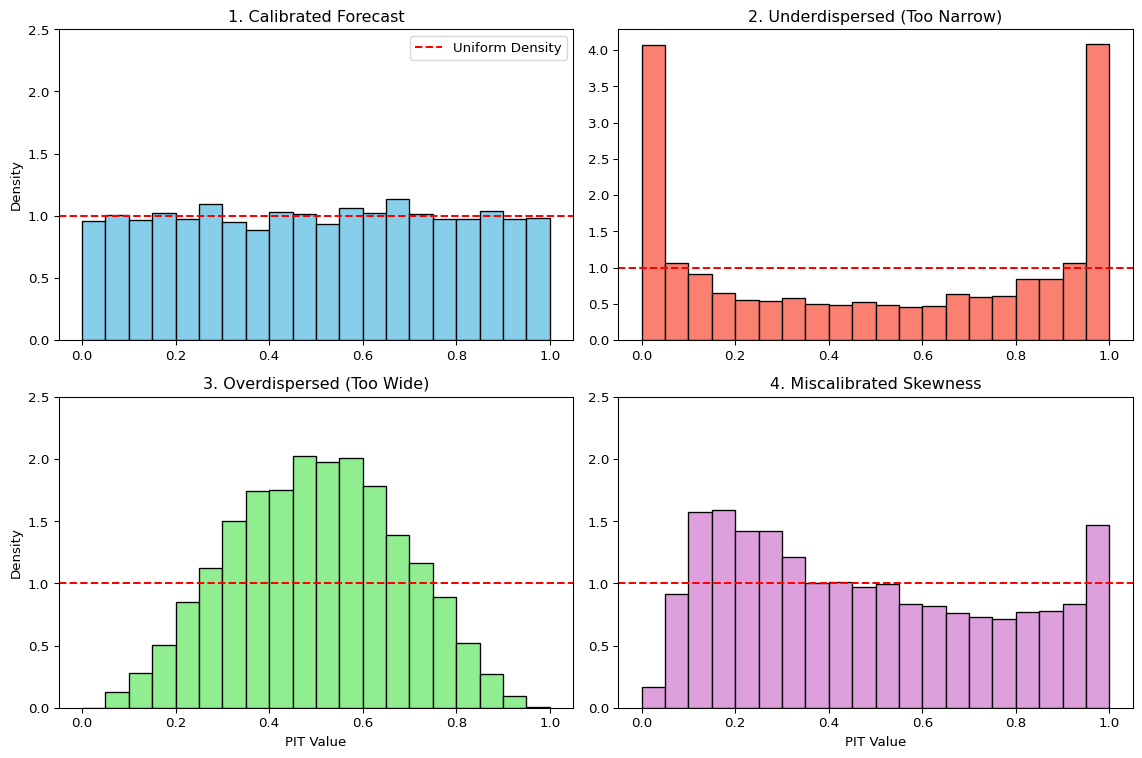
A histogram of the PIT values checks their marginal uniformity. Its shape can reveal systematic biases in the forecast distributions:
Calibrated Forecasts: If the forecasts are well-calibrated, the PIT histogram will be approximately flat, resembling a uniform distribution.
Underdispersed Forecasts (Too Narrow): If the forecast distributions are consistently too narrow, the realized outcomes will frequently fall in the tails. This leads to PIT values clustering near 0 and 1, creating a U-shaped histogram. The model is “overconfident” and surprised too often.
Overdispersed Forecasts (Too Wide): If the forecast distributions are consistently too wide, the realized outcomes will tend to fall in the center of the distributions. This leads to PIT values clustering around 0.5, creating a hump-shaped histogram. The model is “underconfident” in its uncertainty.
Miscalibrated Skewness: An asymmetric histogram indicates a shape mismatch, but skewness and matching first two moments alone do not determine a unique PIT shape. In the skew-normal simulation below, the outcomes are right-skewed and the symmetric forecast matches their mean and variance. For this data-generating process, realizations cluster around a mode below the symmetric forecast’s center, producing a hump to the left of 0.5; the light left tail produces a deficit near 0; and the heavy right tail produces some extra mass near 1. Other right-skewed distributions can produce different asymmetric PIT patterns.
Show the code
import numpy as npimport matplotlib.pyplot as pltfrom scipy.stats import norm, skewnorm# --- Simulation Setup ---n_samples =5000np.random.seed(42)# --- Calculate PIT values for different forecast scenarios ---# 1. Calibrated: True data is Normal, forecast is Normaly_true_norm = norm.rvs(loc=0, scale=1, size=n_samples)pit_calibrated = norm.cdf(y_true_norm, loc=0, scale=1)# 2. Underdispersed: True data is Normal, forecast is too narrowpit_underdispersed = norm.cdf(y_true_norm, loc=0, scale=0.5)# 3. Overdispersed: True data is Normal, forecast is too widepit_overdispersed = norm.cdf(y_true_norm, loc=0, scale=2.0)# 4. Skewness Mismatch: True data is skewed, forecast is symmetric Normalskew_param =5y_true_skewed = skewnorm.rvs(a=skew_param, loc=0, scale=1, size=n_samples)# Forecast: Normal distribution matched to the *population* mean and variance# of the skew-normal DGP (not estimated from the evaluated outcomes)mu_forecast, var_forecast = skewnorm.stats(a=skew_param, loc=0, scale=1, moments='mv')pit_skew_mismatch = norm.cdf(y_true_skewed, loc=mu_forecast, scale=np.sqrt(var_forecast))# --- Plotting ---fig, axes = plt.subplots(2, 2, figsize=(12, 8))ax1, ax2, ax3, ax4 = axes.flatten()bins = np.linspace(0, 1, 21)# Calibratedax1.hist(pit_calibrated, bins=bins, density=True, color='skyblue', edgecolor='black')ax1.axhline(1.0, color='red', linestyle='--', label='Uniform Density')ax1.set_title('1. Calibrated Forecast')ax1.set_ylabel('Density')ax1.legend()# Underdispersedax2.hist(pit_underdispersed, bins=bins, density=True, color='salmon', edgecolor='black')ax2.axhline(1.0, color='red', linestyle='--')ax2.set_title('2. Underdispersed (Too Narrow)')# Overdispersedax3.hist(pit_overdispersed, bins=bins, density=True, color='lightgreen', edgecolor='black')ax3.axhline(1.0, color='red', linestyle='--')ax3.set_title('3. Overdispersed (Too Wide)')ax3.set_xlabel('PIT Value')ax3.set_ylabel('Density')# Skew Mismatchax4.hist(pit_skew_mismatch, bins=bins, density=True, color='plum', edgecolor='black')ax4.axhline(1.0, color='red', linestyle='--')ax4.set_title('4. Miscalibrated Skewness')ax4.set_xlabel('PIT Value')for ax in axes.flatten(): ax.set_ylim(0, max(ax.get_ylim()[1], 2.5)) # Ensure y-axis is comparableplt.tight_layout()plt.show()
Figure 4.4: PIT histograms for four simulated forecast–outcome configurations (N=5{,}000 draws each): a correctly specified Gaussian forecast (top left), a forecast that is too narrow (top right), a forecast that is too wide (bottom left), and a symmetric Gaussian forecast facing right-skewed outcomes (bottom right). The dashed red line marks the uniform density that a calibrated forecast reproduces.
The PIT histogram complements scoring rules: scoring rules rank models, PIT histograms diagnose why a model’s predictive distributions are deficient. For dependent data, the PIT should be paired with serial-dependence diagnostics on the PIT sequence.
4.9 Connection to Information Theory
Proper scoring rules connect directly to entropy and cross-entropy from the Information Theory chapter. The link is most direct for the Logarithmic Score.
Let’s assume there is a true, underlying data-generating distribution with density p(y), and our model produces a forecast distribution with density q(y).
The LogS for a single observation y is:
\text{LogS}(q, y) = -\log q(y)
To evaluate the quality of our forecasting model q in general, we consider its expected score under the true distribution p:
This expression is exactly the definition of the continuous-case cross-entropyh_{ce}(p, q) between the true density p and the forecast density q—written with a lowercase h, keeping the convention from the Information Theory chapter that distinguishes differential quantities from their discrete counterparts \mathbb{H}.
4.10 Minimizing the LogS is Minimizing the KL Divergence
Recall the fundamental relationship from information theory:
This identity decomposes the expected log score into two pieces:
Differential entropy h(p): the irreducible uncertainty in the true data-generating process. It is the best possible average score, achieved when q=p. Recall that a differential entropy can be negative; that is harmless here, because scores are compared across models rather than read on an absolute scale.
KL Divergence D_{\text{KL}}(p \parallel q): the extra loss incurred because q differs from p. Since D_{\text{KL}} \geq 0, this term is the room for improvement (closely related to the discussion of maximum likelihood estimation (MLE) as KL minimization).
Implication
Minimizing the expected LogS is equivalent to minimizing the KL divergence between the model’s predictive distribution q and the true data-generating distribution p. A sample average of LogS values estimates this expectation, so the equivalence extends to empirical model comparison in large samples under the usual integrability and law-of-large-numbers conditions. This equivalence is the theoretical foundation for using the LogS in model selection and evaluation.
Advanced: CRPS and Generalized Entropy
CRPS also admits an interpretation in terms of a generalized entropy. Write F for a forecast CDF, matching the convention of the CRPS definition above, and let the outcome have true CDF F_0. The CRPS is
where we used \mathbb E[\mathbf{1}\{z \geq Y\}]=F_0(z) and \operatorname{Var}(\mathbf{1}\{z \geq Y\})=F_0(z)(1-F_0(z)).
The term h_{\text{CRPS}}(F_0)=\int F_0(z)(1-F_0(z))\,dz is the generalized “CRPS entropy” of the outcome distribution F_0.
The excess risk D_{\text{CRPS}}(F_0,F)=\int_{-\infty}^{\infty} (F_0(z)-F(z))^2\,dz is the Cramér distance between F_0 and F. It is nonnegative and vanishes only when the two CDFs agree everywhere: equality almost everywhere implies equality everywhere by right-continuity of CDFs. This makes CRPS strictly proper, minimized at F(z)=F_0(z) for all z. Note the naming: the Cramér distance integrates the squared CDF gap against Lebesgue measure, dz, as displayed above. The Cramér–von Mises criterion integrates the same squared gap against dF_0(z) and is a different functional.
The last expression can be used to define a multivariate CRPS analogue called the energy score.
4.11 Empirical Application: GDP Growth Density Forecasts
The tools introduced in this chapter—LogS, CRPS, and PIT histograms—are most informative when applied to competing density forecasts on the same data. We use the FRED-QD (Federal Reserve Economic Data, Quarterly Database) macroeconomic panel documented in the datasets appendix; the same panel returns in the tree-based chapters later in the book. The target is annualized one-step-ahead real GDP growth, and the predictors are five lagged macro and financial variables: lagged GDP growth, inflation, term spread, log VIX (the Cboe Volatility Index), and the unemployment rate. This is a pedagogical final-vintage-data example, not a fully real-time evaluation: a real-time design would also need to reconstruct data revisions and publication lags at every forecast origin.
If random forests are new to you
You can consult the random forests chapter, or simply think of a random forest here as another forecasting model that maps predictors to a prediction. Its internal workings are not needed to follow this illustration. The focus is on constructing forecasts of the conditional mean and variance, then evaluating the resulting predictive distributions using LogS, CRPS, and PIT histograms.
We use the following notions in this section:
A mean forest predicts the conditional mean of the target variable given the predictors.
A variance forest predicts the conditional variance of the target variable given the predictors.
We compare three density forecasts, all Gaussian. The first-order autoregressive (AR(1)) baseline sets the point forecast to a least-squares AR(1) in lagged GDP growth and the variance to the expanding in-sample residual variance, estimated by dividing the residual sum of squares by n-2 for the fitted intercept and slope—a quantity that stays roughly constant once enough data are available. The heteroskedastic random forest (in-sample)—we abbreviate random forest as RF below—uses two forests: a mean forest that predicts the conditional mean from all five predictors, and a variance forest that regresses the squared in-sample residuals of the first forest on the same predictors. This two-model construction is analogous to specifying a mean equation and a variance equation separately, as is done, for example, in generalized autoregressive conditional heteroskedasticity (GARCH) models. The heteroskedastic random forest (OOB) uses the same architecture but feeds the variance forest squared out-of-bag (OOB) residuals from the mean forest instead.1 We deliberately include both heteroskedastic variants because the two differ only in one design choice—how the residuals fed to the variance forest are produced—and that single choice will turn out to determine whether the model beats or loses to the AR(1) baseline.
All three models are evaluated on the last 25% of the sample, a test window we will reuse in the tree-based chapters. One indexing convention in the code below deserves a sentence: each row of the assembled dataset pairs the predictors observed at forecast origin t with the outcome realized in the following quarter. The DataFrame column y therefore holds y_{t+1} in row t; inside the expanding-window loop, the scalar y_next reads that row’s value.
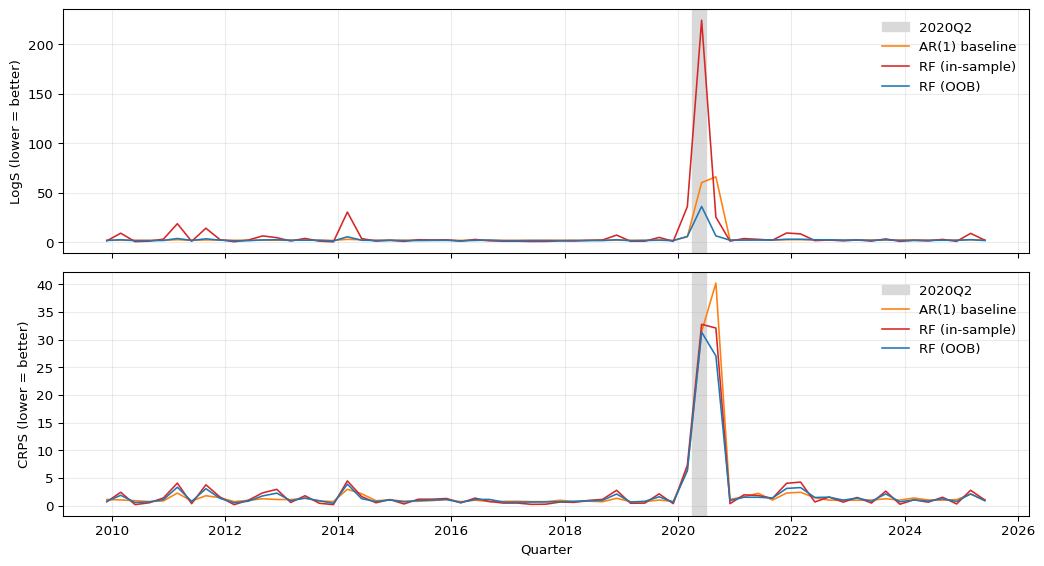
Figure 4.5: Per-quarter LogS (top panel) and CRPS (bottom panel), for both of which lower values are better, for the AR(1) baseline (orange), the in-sample heteroskedastic random forest (red), and the OOB heteroskedastic random forest (blue), evaluated on the last 25% of the FRED-QD sample. The gray shading marks the COVID-19 contraction quarter (2020Q2).
The top panel of Figure 4.5 shows LogS over time. All three models register a sharp spike in 2020Q2, the quarter in which GDP fell by roughly 30 percent annualized. Because LogS evaluates the density at the realized outcome, a single quarter that falls far into the left tail—where any Gaussian forecast places near-zero density—can inflate the average LogS dramatically. The spike is by far the largest for the in-sample RF: its variance forest had been predicting a small conditional variance going into 2020, so the resulting density at -32.8\% is essentially zero. The OOB RF produces a larger variance forecast for that quarter, so its 2020Q2 spike is smaller; the AR(1) sits in between. The bottom panel plots CRPS over the same period. All three models deteriorate in 2020Q2. For the in-sample RF, the spike dominates its CRPS series far less than the corresponding spike dominates its LogS series (the two scores live on different scales, so only such within-score comparisons are meaningful): CRPS integrates the CDF discrepancy over all values rather than evaluating the density at one point, so a miss that lands where the predictive density is essentially zero inflates CRPS far less than LogS. For the AR(1) and the OOB RF, whose forecasts were less overconfident going into 2020, the COVID quarter weighs comparably on their CRPS and LogS series.
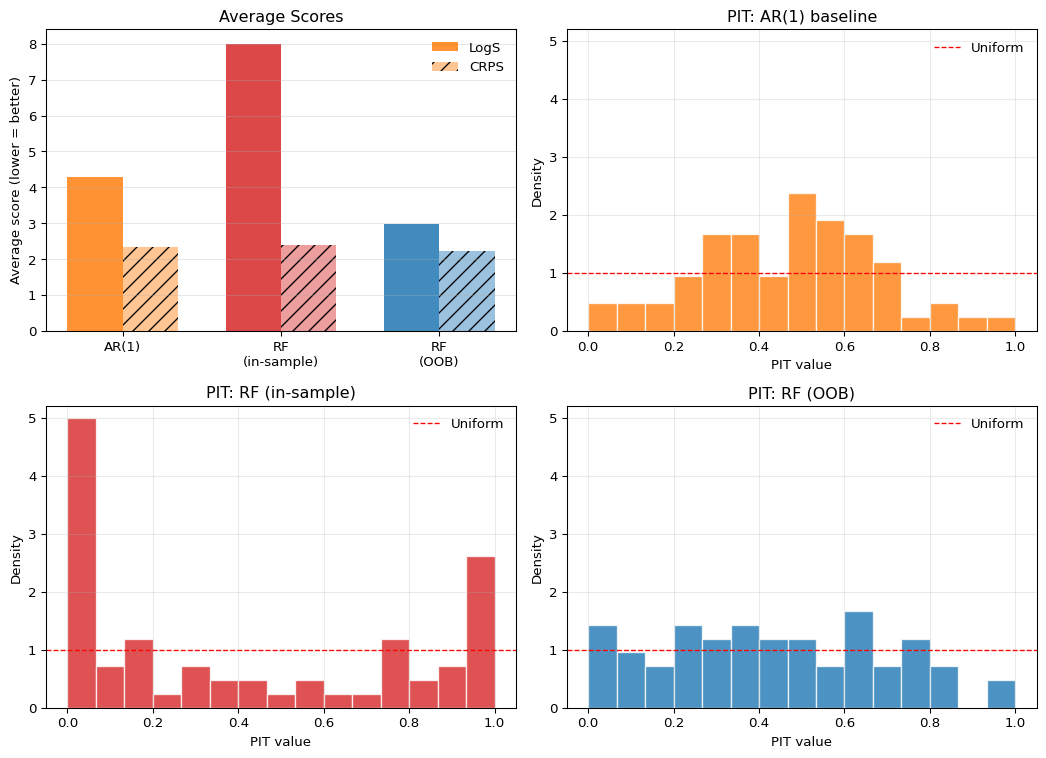
Figure 4.6 condenses the evaluation: average scores in the first panel and PIT histograms for each model in the remaining panels. Two reading aids matter with only 63 test quarters. First, we use eight bins, so that roughly eight observations per bin are expected under uniformity; finer bins would mostly display noise. Second, the shaded band around the uniform density marks pointwise ±2-standard-error variation of the bin heights under an i.i.d. Uniform(0,1) PIT reference. Marginal uniformity alone does not justify this band when PITs are serially dependent. The band is a visual reference rather than a simultaneous confidence band or a formal calibration test: a bar outside the band is conspicuous, but a coordinated pattern across bins can also warrant investigation when every individual bar remains inside. We inspect only the marginal shape of the PITs here; testing for leftover serial dependence in the PIT sequence—the second half of the diagnosis in Section 4.8—requires additional tools, and Exercise 4.3 develops the closely related serial-correlation problem for average-score comparisons.
Figure 4.6: Average LogS (solid bars) and CRPS (hatched bars) by model in the top-left panel, lower is better, and PIT histograms for each model over the T=63 test quarters in the remaining panels, using 8 bins. The dashed red line marks the uniform density; the shaded band is a pointwise ±2-standard-error region under i.i.d. Uniform(0,1) PITs, based on binomial bin-count variation. It is not adjusted for serial dependence under marginal uniformity alone. LogS and CRPS are on different scales, so bar heights in the top-left panel are comparable across models within a score, not between the two scores.
The top-left panel of Figure 4.6 reports average scores. The in-sample heteroskedastic RF loses to the AR(1) baseline on both LogS and CRPS, but by very different margins: the LogS gap is large, because the small predicted variance produces near-zero density at the COVID realization, while the CRPS gap is barely visible at the plotted scale—the score that is not dominated by the single tail miss hardly separates the two models. The OOB heteroskedastic RF wins on both LogS and CRPS over this test window—in the sample-average sense; the caveats below apply before any stronger claim. The two RFs differ only in whether the variance forest is trained on in-sample or out-of-bag residuals, yet that single design choice flips the ranking against the baseline.
Two caveats apply before reading too much into the ranking. First, these are raw average scores over a short test window of 63 quarters, and we report no formal test on the score differences; a rigorous comparison would apply a Diebold–Mariano-type test with a heteroskedasticity-and-autocorrelation-consistent (HAC) variance estimator to the loss-differential series (Francis X. Diebold and Mariano 1995), exactly because score differentials are serially correlated in dependent data; the conditional predictive-ability extension of Giacomini and White (2006) accommodates estimated models but requires a rolling or fixed estimation window of bounded size, so it does not cover the expanding-window scheme used here. Second, the average-LogS gap is driven to a large extent by a single observation—the COVID collapse of 2020Q2, where the in-sample random forest’s tiny predicted variance produces an enormous log-score penalty. Averages of unbounded scores over short windows can hinge on one such realization, which is a caution worth keeping in mind whenever LogS rankings are reported without inference.
The PIT histograms in the remaining panels help explain the ranking. The AR(1) PIT is mildly hump-shaped: with its constant in-sample residual variance, it is, if anything, slightly overdispersed in the relatively calm post-2009 period. The in-sample RF PIT is sharply U-shaped, with very large mass near 0 and 1—the classic signature of an underdispersed predictive distribution. This pattern is consistent with same-sample residual shrinkage: training the variance equation on residuals from a mean forest fitted to the same observations can make the estimated conditional variance too small, producing Gaussian densities that are too narrow. The OOB RF PIT is the flattest of the three, with no edge spikes and a mostly even spread across the unit interval. Replacing in-sample residuals with out-of-bag residuals reduces this mechanical shrinkage and gives the variance forest a less compressed target to learn.
This is the central pedagogical point of the application. A flexible machine-learning (ML) model that adds a learned variance equation does not automatically beat a simple AR(1): in this application, using residuals from an overfit mean equation is associated with worse scores and an underdispersed PIT histogram. The PIT evidence is consistent with that failure mode, while the switch to out-of-bag residuals improves both scores in this test sample. This comparison does not establish that residual construction alone causes the improvement or that the OOB architecture will dominate in other samples. Instead, it shows how proper scoring rules and calibration plots can reveal a plausible weakness in a distribution-forecasting pipeline that point-forecast evaluation would miss.
Question for Reflection
All three models use a Gaussian predictive distribution. Suppose the true GDP-growth distribution has the right-skewed skew-normal form used in Figure 4.4, while each Gaussian forecast has the correct mean and variance. What asymmetric PIT pattern would you expect, and which panel corresponds to it? Would right skewness and matching first two moments alone imply this exact pattern? What change to the predictive family would address the misspecification?
Suggested Answer
For the stated skew-normal data-generating process, realizations cluster around a mode below the Gaussian center, creating a hump to the left of 0.5; the light left tail leaves a deficit near 0; and the heavy right tail adds extra mass near 1. This is the miscalibrated-skewness panel in Figure 4.4. Right skewness and matching first two moments alone do not imply this exact histogram: higher-order shape features determine how probability mass is redistributed across the PIT. The natural modification is to replace the Gaussian with a predictive family that supports negative outcomes and allows conditional skewness, such as a skew-normal or skew-t distribution.
4.12 Summary
Key Takeaways
Distribution forecasts describe uncertainty beyond a single point prediction.
Proper scoring rules make the true distribution optimal in expected score, with uniqueness under strict propriety.
LogS evaluates the density at the outcome, while CRPS integrates squared CDF discrepancies across thresholds.
PIT histograms assess probabilistic calibration and complement comparisons based on average scores.
Common Pitfalls
Evaluate forecasts on held-out outcomes, since fitting and assessing them on the same observations can hide misspecification.
A flat PIT histogram does not establish serial independence or justify an independent-sampling reference band.
CRPS is unbounded even though its squared integrand is bounded by one.
Training a variance model on shrunken in-sample residuals can produce overconfident densities; held-out or out-of-bag residuals address that reuse.
4.13 Exercises
Exercise 4.1: Expected LogS Under Gaussian Misspecification
Show that the logarithmic score for a realized outcome y can be written as
\mathrm{LogS}(q,y)=\frac{1}{2}\log(2\pi\sigma^2)+\frac{(y-\mu)^2}{2\sigma^2}.
Compute the expected log score under the true distribution p and show that
\mathbb{E}_{Y\sim p}[\mathrm{LogS}(q,Y)]
=
\frac{1}{2}\log(2\pi\sigma^2)
+\frac{\sigma_0^2+(\mu_0-\mu)^2}{2\sigma^2}.
Show that the expected log score is minimized at
\mu=\mu_0,
\qquad
\sigma^2=\sigma_0^2.
Part 3 shows that expected LogS is minimized only when both the reported mean and variance are correct. Contrast this with evaluating a single point forecast under MSE: which feature of the predictive distribution determines the MSE-optimal point forecast, and why is a separately reported predictive variance not evaluated?
Exam level. The exercise formalizes why LogS evaluates the entire predictive distribution, not just its center.
Hence the expected log score is minimized at the true mean and the true variance. This stationary point is the global minimum: for any fixed \mu, the criterion diverges to +\infty as \sigma^2\to 0, because \sigma_0^2>0, and as \sigma^2\to\infty. For fixed \sigma^2, it increases without bound in (\mu-\mu_0)^2, so the unique stationary point attains the minimum.
Part 4: Why LogS Goes Beyond Point Forecasts
For any point forecast a, expected squared error decomposes as
The variance term does not depend on a, so the MSE-optimal point forecast is the mean a=\mathbb{E}[Y]—or the conditional mean when the forecast is based on an information set. The variance still determines the irreducible minimum expected MSE, but a point forecaster does not report a predictive variance for MSE to evaluate separately.
By contrast, LogS evaluates the full predictive density. A forecaster can get the mean right but still be penalized for reporting a variance that is too small or too large. That is why LogS is suitable for distribution forecasts rather than only point forecasts.
Exercise 4.2: PIT Under Dispersion Misspecification
Suppose the true distribution is standard normal:
Y\sim \mathcal{N}(0,1).
Suppose the forecaster reports the Gaussian predictive CDF
where \Phi and \phi denote the standard normal CDF and PDF.
Define the PIT value by
U=F_\sigma(Y).
Show that for any u\in(0,1),
\mathbb{P}(U\le u)=\Phi\big(\sigma\,\Phi^{-1}(u)\big).
Then differentiate this expression to show that the PIT density is
f_U(u)
=
\sigma\,
\frac{\phi\big(\sigma\Phi^{-1}(u)\big)}{\phi\big(\Phi^{-1}(u)\big)},
\qquad 0<u<1.
Show that if \sigma=1, then U\sim \mathrm{Uniform}(0,1).
Show that
f_U(u)=\sigma\exp\left(\frac{1-\sigma^2}{2}\big(\Phi^{-1}(u)\big)^2\right).
Use this to explain why the PIT histogram is U-shaped when \sigma<1 and hump-shaped when \sigma>1.
Exam level. This exercise turns the usual PIT intuition into an explicit distributional calculation.
Hint for Part 1
Use that \Phi is strictly increasing:
U\le u
\quad\Longleftrightarrow\quad
\Phi\left(\frac{Y}{\sigma}\right)\le u.
Differentiate \Phi(\sigma \Phi^{-1}(u)) using the chain rule and
If \sigma<1, then 1-\sigma^2>0, so the exponent is positive and grows with |\Phi^{-1}(u)|. Therefore the density is large near the edges u\approx 0 and u\approx 1, which gives a U-shaped PIT histogram. This corresponds to an underdispersed forecast.
If \sigma>1, then 1-\sigma^2<0, so the density is damped in the tails and relatively larger near the center. This gives a hump-shaped PIT histogram, corresponding to an overdispersed forecast.
Exercise 4.3: Comparing Average Scores Under Serial Correlation
Two density forecasters, A and B, issue predictive distributions for the same target series at the same forecast horizon, and both are evaluated with the same proper scoring rule. Let \delta_t denote the score differential in period t—the score of forecaster A minus the score of forecaster B, each evaluated at the realized outcome—and assume \{\delta_t\} is covariance stationary with mean \mu=\mathbb{E}[\delta_t] and autocovariances \gamma_\ell=\operatorname{Cov}(\delta_t,\delta_{t-\ell}) satisfying \sum_{\ell=0}^{\infty}|\gamma_\ell|<\infty. These assumptions deliver the variance calculations below and a finite long-run variance. Equal predictive ability corresponds to H_0:\mu=0. For a formal t-test, additionally assume \sqrt{T}(\bar\delta-\mu)\Rightarrow\mathcal N(0,\Omega) with strictly positive long-run variance \Omega=\gamma_0+2\sum_{\ell\ge1}\gamma_\ell>0, and consistency of the chosen HAC estimator; those conclusions require further moment and weak-dependence conditions, together with suitable kernel and bandwidth choices for the HAC estimator.
Show that
\operatorname{Var}(\bar\delta)
=\frac{1}{T}\left[\gamma_0+2\sum_{\ell=1}^{T-1}\left(1-\frac{\ell}{T}\right)\gamma_\ell\right].
Suppose the differential has the moving-average structure
\delta_t=\mu+\varepsilon_t+\theta\varepsilon_{t-1},
\qquad \varepsilon_t\ \text{i.i.d.},\quad \mathbb{E}[\varepsilon_t]=0,\quad \operatorname{Var}(\varepsilon_t)=\sigma_\varepsilon^2>0.
Derive \gamma_0, \gamma_1, and \gamma_\ell for \ell\ge 2, and show that
T\operatorname{Var}(\bar\delta)\ \longrightarrow\ \sigma_\varepsilon^2(1+\theta)^2
\qquad\text{as } T\to\infty.
An analyst ignores the dependence and uses the i.i.d.-based variance \gamma_0/T. Show that the ratio of the correct asymptotic variance to this naive variance is (1+\theta)^2/(1+\theta^2), evaluate it at \theta=1, and state what the result implies for the naive standard error.
Explain why serially correlated score differentials arise naturally in forecast evaluation—for example with multi-step or overlapping forecast targets.
Exam level. The exercise transfers the HAC logic familiar from regression inference to proper-score comparisons.
The double sum contains T pairs with t=s, each contributing \gamma_0, and for each lag \ell=1,\dots,T-1 exactly 2(T-\ell) pairs with |t-s|=\ell, each contributing \gamma_\ell. Therefore
which equals 4/2=2 at \theta=1: the true variance of \bar\delta is twice the naive one, so the naive standard error is too small by a factor \sqrt{2} and the associated t-statistic is inflated by the same factor. (The direction is governed by the sign of the autocorrelation: at \theta=-1/2 the ratio is 0.25/1.25=0.2, so the naive standard error would instead be too large. Positive autocorrelation is the empirically typical case for score differentials.)
Part 4: Implications for Forecast Evaluation
Serially correlated differentials are common in forecast evaluation rather than exceptional. For h-step-ahead targets, forecast errors overlap in h-1 innovations, so under standard conditions they follow a moving average of order h-1 even for a correctly specified model, and the loss differential typically inherits serial correlation of a similar range; estimated parameters and persistent volatility add further dependence.
Diebold, Francis X., Todd A. Gunther, and Anthony S. Tay. 1998. “Evaluating Density Forecasts with Applications to Financial Risk Management.”International Economic Review 39 (4): 863–83. https://doi.org/10.2307/2527342.
Diebold, Francis X, and Robert S Mariano. 1995. “Comparing predictive accuracy.”Journal of Business and Economic Statistics 13 (3): 253–63. https://doi.org/10.1080/07350015.1995.10524599.
Gneiting, Tilmann, and Adrian E. Raftery. 2007. “Strictly proper scoring rules, prediction, and estimation.”Journal of the American Statistical Association 102 (477): 359–78. https://doi.org/10.1198/016214506000001437.
Jordan, Alexander, Fabian Krüger, and Sebastian Lerch. 2019. “Evaluating probabilistic forecasts with scoringRules.”Journal of Statistical Software 90 (12): 1–37. https://doi.org/10.18637/jss.v090.i12.
Kleen, Onno. 2024. “Scaling and Measurement Error Sensitivity of Scoring Rules for Distribution Forecasts.”Journal of Applied Econometrics 39 (5): 833–49. https://doi.org/10.1002/jae.3056.
Székely, Gábor J. 2003. “E-Statistics: The Energy of Statistical Samples.” Technical Report 03-05. Bowling Green State University, Department of Mathematics; Statistics.
Footnotes
Within this final-vintage design, all forests are re-estimated on the expanding window ending at the forecast origin, so no later-dated rows enter estimation. The in-sample variance forest uses squared residuals \hat\varepsilon_s^2=(y_s-\hat\mu_s)^2, where the mean forest used observation s during fitting. These same-sample residuals can therefore be mechanically too small, which can train the variance forest toward overly narrow Gaussian forecasts. The out-of-bag variant instead uses, for each training observation, the average prediction from trees whose bootstrap samples excluded that observation (Breiman 2001). This removes direct reuse of the observation in its own mean prediction and reduces that particular channel of overfitting. It does not turn the residual into a real-time forecast error: an early training observation can still be predicted by trees fitted on later-dated observations within the current training window, and temporal dependence remains. The np.clip(..., 1e-6, None) guard imposes a strictly positive lower bound on the predicted variance, preventing zero-scale Gaussian forecasts and numerically extreme LogS values.↩︎